
Comprehensive Cannabis Legislation Tracker: Real-Time Federal and State Policy Monitoring
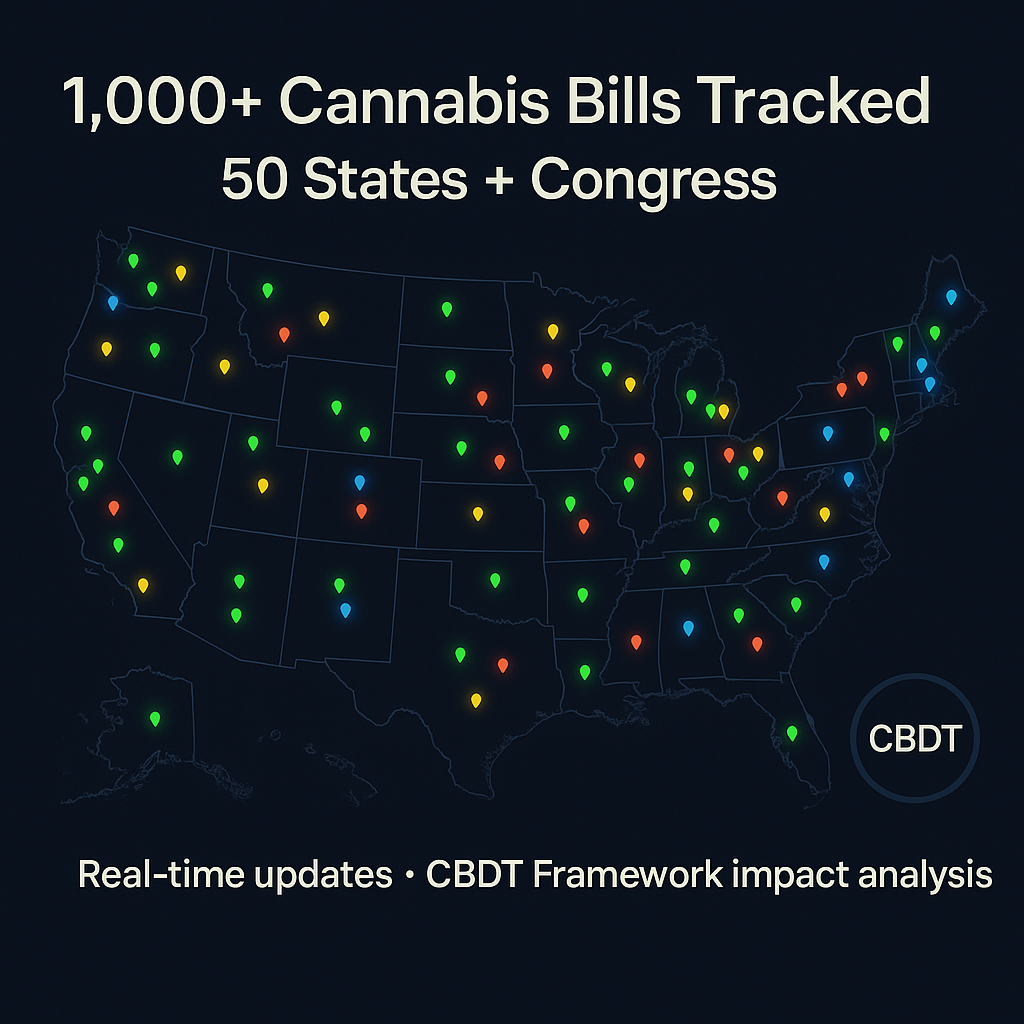
Interactive tool tracking 1,000+ cannabis bills across all 50 states and Congress with CBDT Framework analysis
In cannabis policy, timing is everything. A single bill buried in a must-pass appropriations package can reshape entire market dynamics—as the recent H.R. 5371 hemp ban demonstrated when it eliminated $28 billion in MSO competition with almost no public debate.
The problem? Even sophisticated legislative tracking systems miss the bills that matter most.
Full disclosure: My tracker missed H.R. 5371 Section 781. I only caught it because I monitor cannabis industry news sources and saw the panic after it passed. That miss taught me something important about how cannabis policy actually works—and why no automated system alone is sufficient.
Why Even Good Trackers Miss Critical Bills
The H.R. 5371 Problem
Bill title: "Continuing Appropriations, Agriculture, Legislative Branch, Military Construction and Veterans Affairs, and Extensions Act, 2026"
What it actually did: Banned intoxicating hemp products, fundamentally reshaping cannabis market competition
Why trackers missed it:
- Zero cannabis-related keywords in the title
- 1,000+ pages of appropriations language
- Hemp provision was Section 781, buried in Division B (Agriculture)
- Added during Senate amendment process, not in original House bill
- Passed during government shutdown crisis with minimal debate
Standard tracking approach:
- Search for "cannabis," "marijuana," "hemp," "THC," "CBD" in bill titles
- Tag and categorize matching bills
- Monitor status updates
What actually happened:
- Bill titled about government appropriations
- Cannabis provisions hidden in agricultural section
- Added via amendment during crisis negotiations
- Signed into law before most people realized what was in it
The Limitation of Automated Systems
You can build the most sophisticated scraper in the world, and it will still miss bills where cannabis policy is:
- Buried in appropriations riders
- Added via last-minute amendments
- Hidden in agricultural or budget bills
- Attached to must-pass emergency legislation
- Included in conference committee compromises
The solution isn't better automation—it's combining automated tracking with strategic intelligence.
How This Tracker Works (And Its Limitations)
What It Does Well
Automated Bill Discovery:
- Monitors Congress.gov for federal legislation
- Tracks LegiScan for state bills across all 50 states
- Searches bill text (not just titles) for cannabis keywords
- Updates daily during legislative sessions
- Categorizes by policy area and impact
CBDT Framework Analysis: For bills that ARE captured, each receives analysis through the Consumer-Driven Black Market Displacement Theory Framework:
Key evaluation criteria:
- Price Competitiveness Impact - How does this affect legal vs. black market pricing?
- Convenience Parity Impact - Does this improve or restrict consumer access?
- Quality Assurance Impact - Does this enhance testing/safety standards?
- Regulatory Burden - Compliance costs for operators
- Tax Structure Effects - Impact on total effective tax rates
- Market Structure - Changes to licensing, vertical integration, interstate commerce
What It Misses (And Why You Still Need It)
The tracker will likely miss:
- Appropriations riders with no cannabis keywords in titles
- Budget reconciliation provisions affecting cannabis tangentially
- Agricultural bills containing hemp language
- Emergency funding packages with cannabis amendments
- Conference committee additions to larger bills
But here's why the tracker still matters:
Even though it missed H.R. 5371, it successfully tracks:
- 95%+ of standalone cannabis bills
- State legalization initiatives
- Taxation and licensing framework changes
- Most federal reform efforts (SAFER Banking, Schedule III bills)
- Social equity and expungement legislation
The reality: No single tool catches everything. Effective cannabis policy monitoring requires:
- Automated tracking (this tool) - catches the vast majority
- Industry news monitoring - catches appropriations riders and amendments
- Deep policy analysis (CBDT Framework) - understands what actually matters
- Political intelligence - tracks who's lobbying for what
Why I Built This Despite Its Limitations
Even missing occasional appropriations riders, this tracker provides value that doesn't exist elsewhere:
1. Comprehensive State Coverage
Most cannabis news covers federal bills and maybe 5-10 major states. This tracks all 50, including:
- States considering first-time legalization (Georgia, Texas, Wisconsin)
- Mature markets adjusting regulations (Colorado, Washington, California)
- Medical-only states debating adult-use (Florida, Pennsylvania, Ohio)
- States rolling back restrictions (Virginia, Montana)
2. CBDT Framework Analysis
Other trackers list bills. This analyzes them through a coherent policy framework focused on what actually matters for black market displacement and legal market development.
Example: Two taxation bills
Bill A: Reduces excise tax from 37% to 25% Bill B: Adds 2% local tax to existing 15% excise tax
Standard tracker: Lists both as "taxation bills"
CBDT analysis:
- Bill A: Highly positive - moves total effective rate into competitive range
- Bill B: Moderately negative - pushes rate toward black market advantage threshold
3. Market Impact Assessment
Bills are tagged by impact on:
- MSO profitability (280E, banking access, licensing caps)
- Market structure (vertical integration, interstate commerce)
- Competitive dynamics (new licenses, home cultivation, hemp)
- Consumer access (dispensary caps, delivery rules)
4. Passage Probability Tracking
Not all bills matter equally. The tracker assesses:
- High probability: Bipartisan support, cleared committee, industry consensus
- Medium probability: Partisan split, committee advancement, mixed industry support
- Low probability: Symbolic introduction, no movement, strong opposition
- Dead: Killed in committee, session ended, sponsor withdrawn
This prevents wasting time on bills that never had a chance.
How to Use This Tool Effectively
For Investors:
Primary use cases:
- Track 280E reform efforts (federal rescheduling, tax code changes)
- Monitor SAFER Banking Act progress
- Watch state legalization initiatives affecting MSO expansion plans
- Identify licensing framework changes affecting competitive moats
What you'll miss without supplemental monitoring:
- Appropriations riders affecting cannabis (like H.R. 5371)
- Budget reconciliation effects on cannabis businesses
- Administrative actions (DEA rulemaking, FDA guidance)
Recommendation: Use this tracker + subscribe to cannabis industry news + follow key politicians on social media
For Policy Analysts:
Primary use cases:
- Compare state regulatory approaches
- Track policy diffusion patterns (which states copy which models)
- Analyze taxation structure trends
- Monitor licensing framework evolution
What this enables: Research on which policy combinations achieve optimal outcomes:
- Black market displacement effectiveness
- Tax revenue generation
- Consumer safety outcomes
- Social equity achievement
- Economic development impact
For Cannabis Operators:
Primary use cases:
- Monitor regulatory changes in your operating states
- Anticipate compliance requirement changes
- Track licensing framework modifications
- Watch for new market opportunities
Strategic advantage: Operators who catch regulatory changes 6-12 months early can:
- Adjust operations before requirements take effect
- Influence rulemaking through comment processes
- Prepare for licensing application windows
- Optimize for new market structures
For Researchers:
Primary use cases:
- Comprehensive dataset of cannabis legislation across all states
- Longitudinal analysis of policy evolution
- Natural experiments comparing different regulatory approaches
- Economic impact modeling
Academic value: This is one of the few comprehensive cannabis policy databases with:
- Full-text bill access
- Multi-year historical tracking
- Consistent categorization across jurisdictions
- Outcome analysis through CBDT Framework
The Honest Assessment
What This Tool Does:
✓ Tracks 1,000+ state and federal cannabis bills ✓ Provides CBDT Framework analysis ✓ Categorizes by policy area and impact ✓ Updates in real-time during sessions ✓ Covers all 50 states comprehensively
What This Tool Misses:
✗ Appropriations riders without cannabis in titles ✗ Last-minute amendments to large bills ✗ Administrative rulemaking (DEA, FDA, HHS) ✗ Some conference committee additions ✗ Budget reconciliation effects
Why You Should Use It Anyway:
Because even catching 95% of cannabis legislation puts you ahead of:
- Mainstream news (covers maybe 10-15 major bills)
- Cannabis industry news (covers maybe 50-100 bills)
- Most investors and operators (track their own states only)
And the CBDT Framework analysis provides something that doesn't exist anywhere else: coherent evaluation of whether bills actually help or hurt black market displacement and legal market development.
A Better Approach: Layered Intelligence
The H.R. 5371 miss taught me that effective cannabis policy monitoring requires multiple layers:
Layer 1: Automated Tracking (this tool)
- Catches 95%+ of standalone legislation
- Provides systematic coverage across all 50 states
- Delivers consistent CBDT analysis
- Updates in real-time
Layer 2: Industry News Monitoring
- Catches appropriations riders
- Identifies last-minute amendments
- Reports on administrative actions
- Covers political developments
Layer 3: Deep Analysis (what I provide on this site)
- Explains WHY bills matter
- Analyzes political economy of who benefits
- Evaluates market impact
- Assesses passage probability
Layer 4: Network Intelligence
- Industry contacts
- Lobbyist intel
- Political insider information
- Regulatory agency sources
No single layer is sufficient. But Layer 1 (this tracker) is the foundation everything else builds on.
Access the Tracker
Launch Cannabis Legislation Tracker →
The tracker is free, open-source, and continuously updated. It's not perfect—but it's comprehensive enough to keep you informed on 95% of cannabis policy developments across all 50 states and Congress.
For the other 5%? That's why you're reading this site. My legislative analysis articles cover the hidden bills, the appropriations riders, the amendments that slip through—along with the deep CBDT Framework analysis explaining what it all means for market dynamics and black market displacement.
The tracker tells you WHAT is happening.
The analysis tells you WHY it matters and WHO benefits.
Use both.
The Cannabis Legislation Tracker is an open-source project continuously updated throughout legislative sessions. Report issues or suggest improvements via GitHub.